Day 5. Not far upriver (southwards) from Rüdesheim we leave the Rhine River and start travelling on the Mains River. The adventure with the Locks and the low bridges begins. We were warned that the sun deck would be closed for a few dates as we travel up the Mains River due to low bridges. There are also numerous Locks which can slow progress, depending on other boat traffic. We cruised through the night and every so often, you would feel the boat go bump in the night. No, not from us, but from the boat bumping against the walls of the Locks. The traversing of Locks carried on through the morning, with us often having to wait for other boats to progress through them. In all, we travel through 66 sets of Locks.
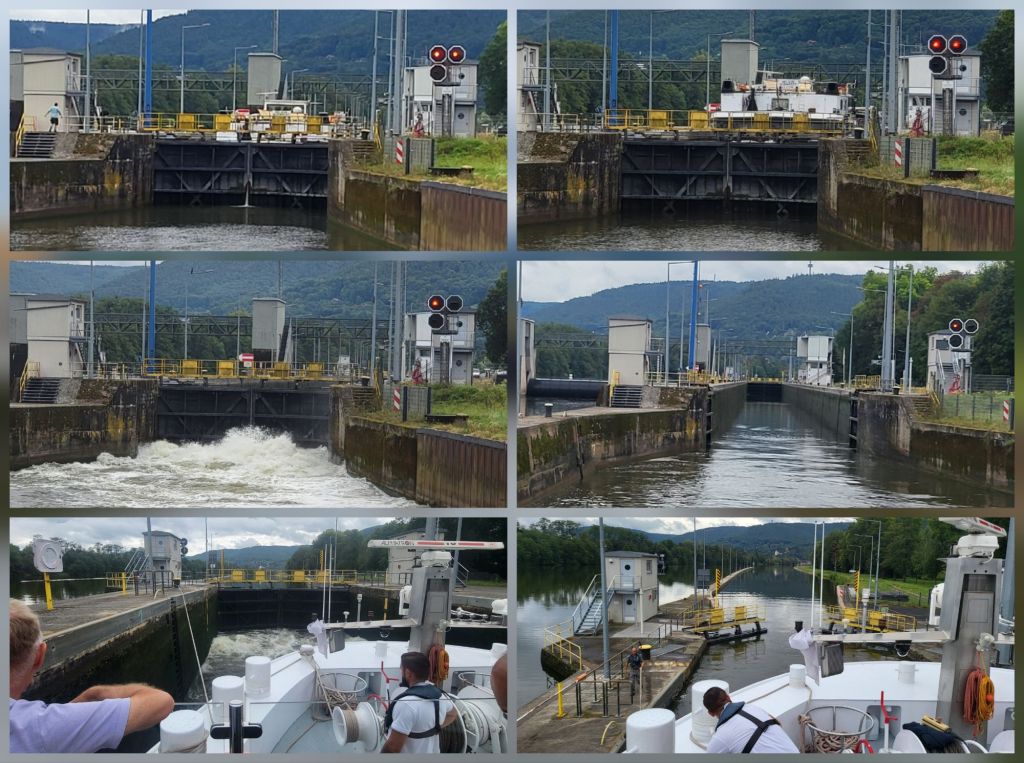
The further along the canal we go, the more impressive the Locks. Up till this stage, the Locks have operated with gates that swing open the whole height, most Locks having a rise of 7m to 14m. Just before and after Nuremberg, there are Locks with a rise of 18m, and then after, 3 Locks of 25m. These Locks use reservoir ponds and reuse 60% of the water. They use a door that rises above the water to traverse the lower level and a door that lowers below water level to allow boats to traverse across the higher level. The whole boat made traversing the first mega-lock an event for which the sun deck was opened temporarily.

The other hazard, which caused the sun deck to be closed, was low bridges. Some bridges are only a few cms clearance over the sun deck, the side rails up there fold down, deck chairs and pergolas are flattened, and the navigation bridge hydraulically lowers into the body of the boat. NOTE: the plastic bottle at the front of the roof ?? If the bridge knocks that over, the Captain knows to duck!!

The weather has also started to turn, with rain and cloudy skies. This is not a bad thing as there was concern over the river levels after a heat wave and the possibility of having to swap ships halfway along where the river level is too low, but seems the rain had resolved that. We have also been lucky with our town visits, the skies seem to clear on cue for our visits.
The Boat. This vessel was built in 2021 and is 135m long, 11.4m wide, with a draught of 1.7m. It has 4 decks with a height of 6.6m. It has 2 x CAT V12 diesels of 32 litre capacity producing 1,000hp with dual omnidirectional double screw pods and a bow thruster. This provides a top speed of 22.5kmph (nb. kmph instead of knots on internal waterways) for its gross of 3500 tonnes.

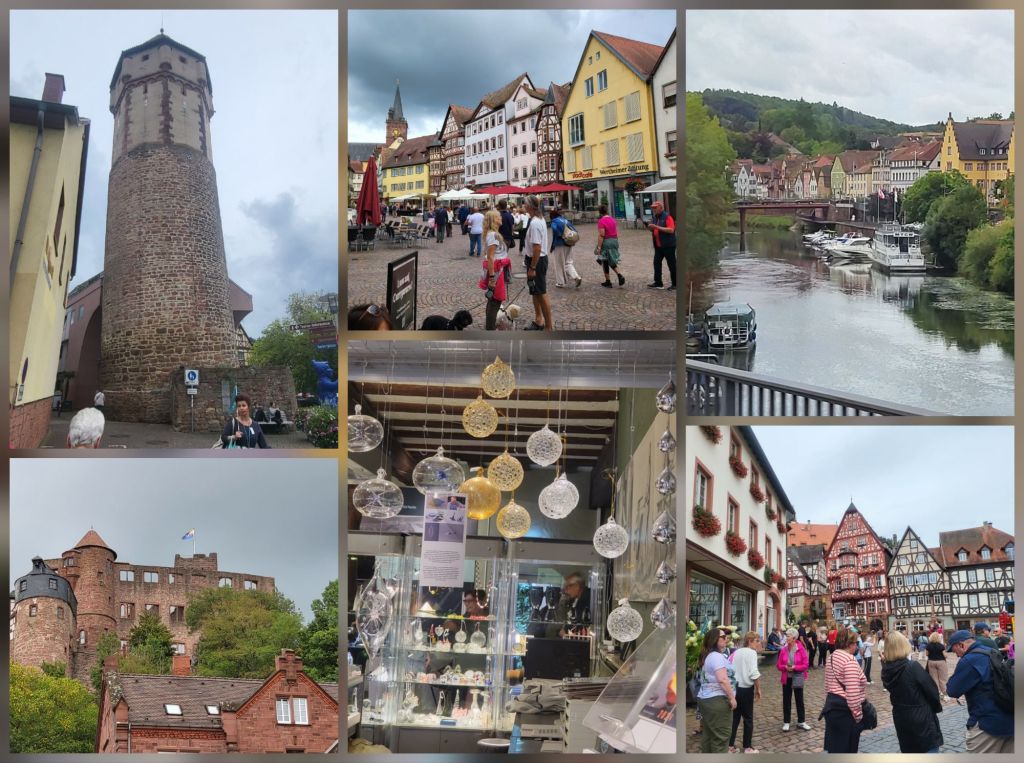
With slow progress through the locks, we were late arriving at our next destination, Miltenberg. At this charming town, we had a walking tour through the Old Town. We disembarked and the boat carried on to the next stop where we would re-embark. The town is known for colourful half-wood houses on cobblestone streets, the ground floor built from limestone, the upper floors from wood. The ground floors are always smaller than the upper floors as tax was calculated on the ground floor area. To make a house large enough to cater for the large families of the time, upper floors overhang the ground floor.

From there, buses took us along the river to the next port of call, Wertheim am Main. This town has a more run-down appearance than Miltenberg as it suffers from floods more, but it is also the centre of glass production and our tour included the Glass Museum with a glass blowing demonstration.
Day 6. We cruised through the night and docked the next morning at Würzburg. This is a wine region and home to the Prince Bishop’s Residence. After having been to the Cathedral at Suzdal, the Cathedral and the Winter Palace at St Petersburg, one would think we had seen it all, but the Bishop’s Residence was unique in its own right. The guides that have taken us through our tours have all been really good, but today’s guide was next level. She studies the history of the period in the college within this Residence’s compound so has an exceptional knowledge of the buildings and the architecture, even to interpret the vast murals and all the subtle symbolisms within.

The town of Würzburg has a different charm to the other towns. It is known for being a wine-producing area, Silvaner being their primary variety. Known as the ‘Pearl of the Romantic Road’, Würzburg is the former capital of Franconia. The buildings are a spectrum of different styles, including Viennese Baroque and secular features from Italy, It was heavily damaged during WWII but has been restored to its former glory.

Day 7. We cruise all night and all morning to Bamberg. This UNESCO World Heritage-listed town boasts one of the largest medieval centres in Europe, with around 2,400 listed buildings gracing its streets. Bamberg is also the home to a ‘smoked’ beer, an acquired taste and not one I sampled.

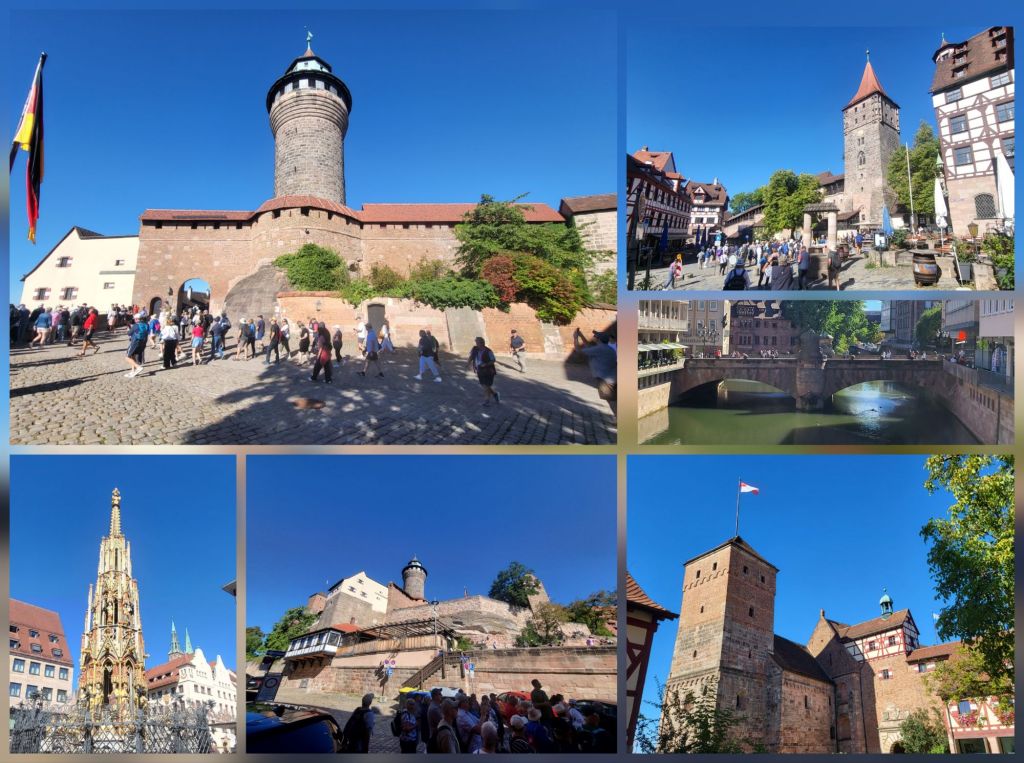
Day 8. We arrived in Nuremberg in the morning and had choices of the type of tour we wanted to do. We chose to go to the castle and town centre. 95% of the old town was destroyed in the bombings of WW2, it was rebuilt to be a replica of how it was before the war. Luckily most of the castle was undamaged but some parts had to be rebuilt.
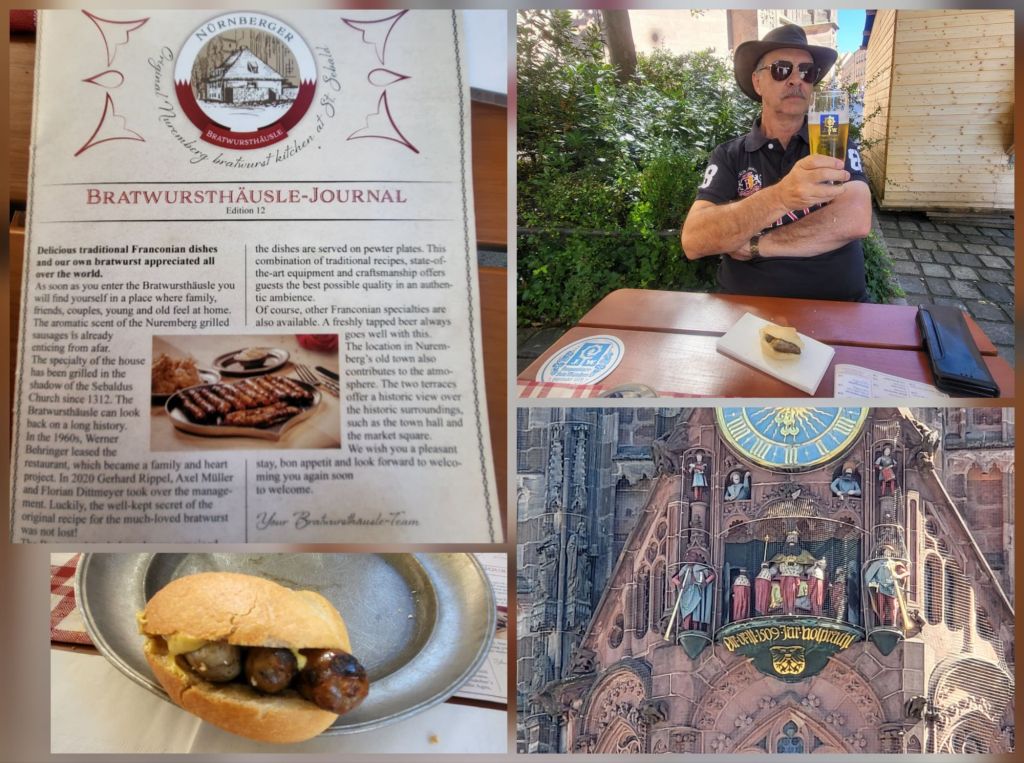
Each German town has its own variety of sausage and Nuremberg is no exception. During the sunny afternoon, after the tour, we sat and had Nuremberg sausage and a local brew. Their sausage and fresh bread roll were rather good!
We reached the highest point in the river this evening, passing the Great Continental Divide marker. West of the Divide, all rivers flow to the North Sea, east they flow to the Black Sea.

We are now going down hill through locks to the Danube, onto the next issue of the blog.


Leave a reply to Vanessa B Cancel reply